
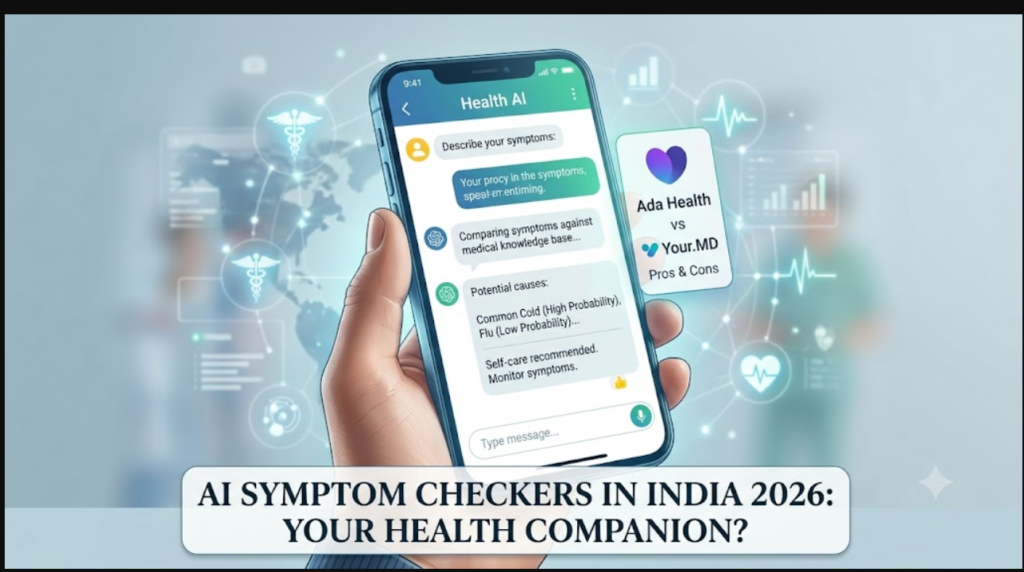
AI Symptom Checkers in India: What They Get Right (and Where They Fail)
That 2 a.m. moment when a strange ache sends you into a search spiral is universal. In 2026, more Indians are skipping the random Google search and opening an AI symptom checker instead — an app that asks a few questions and suggests what might be going on. But how reliable are these tools, and when should you actually use one?
This guide breaks down how AI symptom checkers work, compares the two most talked-about options for Indian users, and lays out clear dos and don’ts so you use them safely.
How AI Symptom Checkers Actually Work
Most symptom checkers use a conversational, question-based model. You describe what you’re feeling, the AI cross-references your answers against a medical knowledge base, and it returns a list of possible causes ranked by likelihood — along with a recommendation on urgency (self-care, see a doctor, or seek emergency help).
Ada Health is generally considered the more clinically rigorous of the two, built with input from physicians and validated against real diagnostic outcomes. Your.MD leans more conversational and wellness-oriented, positioning itself as an everyday health companion rather than a diagnostic-first tool.
Pros of AI Symptom Checkers
| Pros | Why It Matters |
|---|---|
| Available 24/7 | No waiting for clinic hours, useful for late-night worry |
| Reduces unnecessary ER/clinic visits | Helps you triage before deciding where to go |
| Structured questioning | Prevents “Dr. Google” panic spirals from random searches |
| Tracks symptoms over time | Useful pattern data to share with your actual doctor |
| Free tiers available | Low barrier to entry for first-time users |
Cons of AI Symptom Checkers
| Cons | Why It Matters |
|---|---|
| Not a diagnosis | These are probability estimates, not clinical verdicts |
| Over-cautious by design | Many apps escalate to “see a doctor” even for mild symptoms, to limit liability |
| Accuracy varies by condition | Common illnesses are handled well; rare or complex conditions less so |
| Limited context on comorbidities | May not fully account for existing conditions or medication interactions |
| Data privacy concerns | Health data sensitivity means you should check where your data is stored |
You can check for the digital health guidelines provided by WHO here.
Dos and Don’ts
Do:
- Use an AI symptom checker as a first step, not a final answer
- Be precise and honest when describing symptoms — vague inputs give vague outputs
- Share the AI’s summary with your doctor to speed up your actual consultation
- Check the app’s privacy policy before entering sensitive health data
- Treat any “seek emergency care” recommendation seriously
Don’t:
- Don’t use it to self-medicate or avoid seeing a doctor for persistent symptoms
- Don’t rely on it for chest pain, breathing difficulty, or other emergency symptoms — call emergency services directly
- Don’t assume free tools have the same accuracy as clinically validated ones
- Don’t ignore red-flag symptoms just because the AI rated them “low risk”
Where AI Symptom Checkers Fit Into Your Health Toolkit
Symptom checkers are just one category of a much broader shift toward AI-assisted personal health management in India — alongside diet planning, medication tracking, and senior care monitoring. For a full breakdown of the top AI tools for health available to Indian users this year, including how symptom checkers compare against diet planners and monitoring apps, see this detailed guide to the best AI tools for health in India.
FAQs
Is an AI symptom checker as accurate as a doctor? No. AI symptom checkers are designed to guide you toward the right level of care, not replace a clinical diagnosis. Accuracy is highest for common, well-documented conditions.
Are AI symptom checkers free in India? Most offer a free consumer tier with core symptom-checking features, while advanced features or enterprise/clinic versions are paid.
Can AI symptom checkers detect emergencies? They’re generally designed to err on the side of caution and will direct you to emergency care when symptoms match high-risk patterns — but they should never be your only line of defense in a genuine emergency.
This article is for informational purposes only and does not constitute medical advice. Always consult a licensed healthcare professional for diagnosis and treatment.