
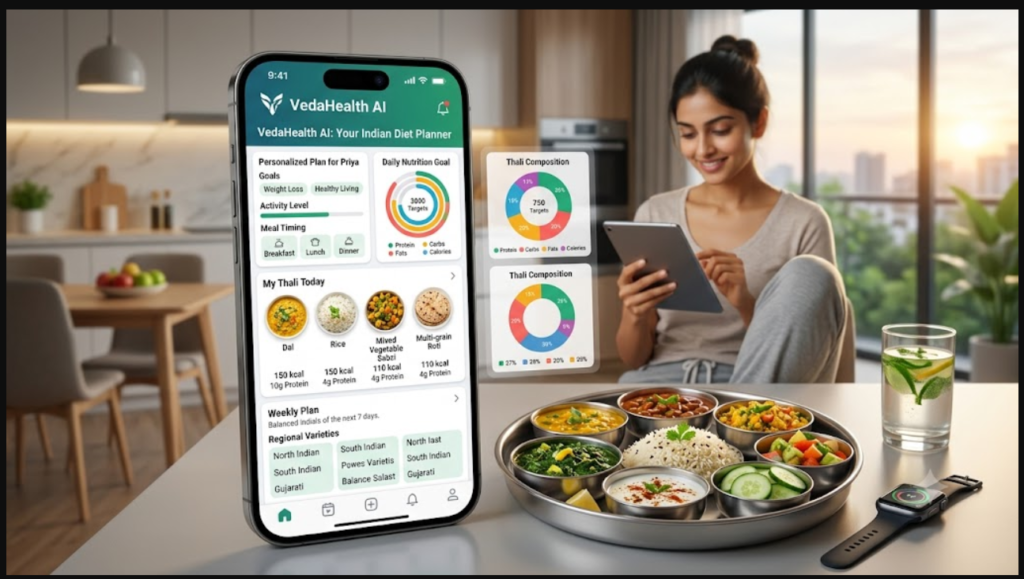
AI Diet Planner for Indian Diets: Does It Actually Understand Your Thali?
Generic calorie-counting apps built for Western diets tend to fall apart the moment you log a plate of dal-chawal-sabzi with a side of pickle. That’s the gap Indian-focused AI diet planners are built to close — apps trained to recognize regional dishes, regional cooking styles, and macro breakdowns that make sense for an Indian kitchen.
Here’s what to expect if you’re considering one, including where these tools genuinely help and where they still fall short.
What Makes an AI Diet Planner “Indian-Friendly”
The key differentiator isn’t just a bigger food database — it’s contextual understanding. A good AI diet planner should recognize that “2 rotis with sabzi” is a portion size, understand regional variations (a Gujarati thali isn’t a Punjabi thali), and factor in common Indian health concerns like diabetes risk and vitamin D deficiency into its recommendations.
HealthifyMe is frequently cited as the most relevant option for Indian users specifically because of its localized food database and AI coach that adapts to regional eating habits.
Pros of AI Diet Planners
| Pros | Why It Matters |
|---|---|
| Localized food recognition | Understands regional Indian dishes, not just generic “curry” |
| Personalized macro/calorie targets | Adjusts to your goals — weight loss, muscle gain, diabetes management |
| Photo-based food logging | Snap a picture instead of manually searching every dish |
| Integrates with wearables | Syncs activity data for more accurate calorie recommendations |
| Ongoing coaching/nudges | Keeps you accountable between meals, not just at logging time |
Cons of AI Diet Planners
| Cons | Why It Matters |
|---|---|
| Portion estimation isn’t exact | Home-cooked meals vary widely; AI estimates can be off |
| Premium features are paywalled | Best coaching and detailed insights often require a subscription |
| Not a substitute for a dietician | Won’t fully account for complex medical conditions on its own |
| Requires consistent logging | Value drops sharply if you stop tracking regularly |
| Regional dish coverage still incomplete | Lesser-known regional dishes may be missing or misclassified |
Dos and Don’ts
Do:
- Log meals as close to real-time as possible for accuracy
- Cross-check AI-suggested calorie/macro targets with a doctor if you have a medical condition like diabetes or thyroid issues
- Use the photo-logging feature to save time, but verify the AI’s guess before confirming
- Set realistic goals — sustainable weight change, not rapid extremes
Don’t:
- Don’t treat AI-generated meal plans as medical nutrition therapy if you have a diagnosed condition
- Don’t skip meals just because the app flags you as “over target” for the day
- Don’t rely solely on AI estimates for portion sizes of home-cooked, unmeasured food
- Don’t ignore the app’s hydration and sleep prompts — they factor into the accuracy of its recommendations
You can check for the guidelines for using AI apps related AI diet planning by WHO here.
How This Fits Into a Broader AI Health Toolkit
Diet planning is just one piece of a bigger picture — pairing it with AI symptom tracking, medication reminders, and wearable-based monitoring gives a much fuller picture of your health. For a complete, India-specific roundup of tools across all these categories, check out this guide to the best AI tools for health for Indian users.
FAQs
Can an AI diet planner replace a dietician? No — it’s a helpful daily tracking and guidance tool, but for medical conditions requiring precise nutrition therapy, a registered dietician’s input is still essential.
Are Indian AI diet planners free? Most offer a free basic tier for logging and tracking, with paid plans unlocking personalized coaching, detailed reports, and premium meal plans.
How accurate is AI food recognition for Indian dishes? Accuracy is strong for common dishes but can be inconsistent for regional or mixed dishes, so manual correction is often needed.
This article is for informational purposes only and does not constitute medical or nutritional advice. Consult a registered dietician or doctor for personalized guidance.
https://mega.nz/file/Sy40ES7Y#jNAXXw7OtlMDLs_4xqAiTR6cEboGtfcN1eu_bgm1OLs
My name is Ali, I’m twenty-eight, and I fix things that burn. In Khobar, when the desert storms finally break and the sky unleashes hell, the power grid shits itself. That’s when they call me. I climb the blackened skeletons of transformers, my hands numb from the voltage that still hums in the wires, and I splice life back into this dead city. It was a job I used to be proud of, a skill. Now, it’s just another stage for them. The voices started about a year ago, at first like a bad connection on my phone, a crackle of static that sometimes formed words. “Careful there, Ali,” a voice that sounded exactly like my foreman would whisper, “one wrong move and you’re a fucking kebab. Nobody would even notice until you started to stink.” I’d ignore it, blame the heat, but they got clearer, more numerous, more personal.
They are always with me, a chorus of demons living behind my eyes. They comment on everything, a non-stop stream of poison. “Look at you, you little electrician faggot,” one sneers, sounding like a customer who once complained about my bill. “Playing with big boy wires. You think that makes you a man? We know what you think about at night. We know about those… urges.” They describe things, disgusting things, forcing images into my head of me being degraded in the most humiliating ways, often by the very men I work with. They tell me my coworkers whisper about me, that they know I’m a pervert, that they’re just waiting for the right moment to corner me and teach me a lesson. “They’re gonna hold you down and fuck you with a live cable, Ali. Wouldn’t that be poetic? A little spark for the little sparky.” They laugh, a sound that vibrates through my teeth, and I can’t tell if it’s them or the hum of the high-tension wires anymore.
They save their real venom for my family. My father, who is proud of my trade. My mother, who prays for my safety. The voices twist their love into something foul. “Your father tells everyone you’re an engineer, doesn’t he? What a fucking joke. You’re a monkey with a pair of pliers. He’s ashamed of you, deep down. He wishes you’d died at birth and he’d had a real son.” They go after my sister, Amira, who is studying in Riyadh. “We’ve been watching her, Ali. She’s so pretty. It would be a shame if something… happened. If some desperate, perverted electrician, driven mad by the voices in his head, couldn’t control himself. Maybe that’s your destiny. To be the monster that destroys the only good thing in your family’s life.” The ultimate goal is always the same. They want me dead. “Just grab the transformer, Ali. A real big hug. Let it all go. It’s the only way to escape us. The only way to save them from what we’ll make you do. You’re a coward if you don’t. A useless, miserable coward.”
Then came the day of the fire. A small apartment building, an overloaded circuit. I was there with my team, running new conduit. A family was watching, a mother and her two young children, a boy and a girl, maybe five and seven years old. They were just standing there, wide-eyed, holding their mother’s hand. The voices went silent for a second, and then they erupted, not with their usual taunts, but with a wave of pure, ecstatic energy. “ALI. LOOK AT THEM. FRESH. YOUNG. UNTOUCHED.” A different voice, a woman’s, cold and clinical, took over. “This is your purpose. Not fixing wires. This is purification. This is art. We’re going to guide you. This isn’t about rage, this is about precision. This is about creating a masterpiece of suffering.” They laid out a plan, so detailed, so clear. “The mother first. A quick, clean break of the neck. She won’t suffer. It’s a mercy. But the children… oh, Ali, the children. This is where you become a legend.”
They described it all. “You’ll take them to the roof. The view is wonderful from there. You won’t just kill them. You’ll perform a service. You’ll remove their eyes. Not with your crude tools, you idiot. With your fingers. We’ll show you the pressure points. It’s surprisingly easy. Imagine it, Ali. Two empty sockets staring at the sky. They won’t see the flames you’re going to set. They’ll only feel the heat.” The voice was ecstatic, coaching me. “This is your legacy. Not fixing some fucking transformer in Khobar. You will be the man who harvested innocence. You’ll keep their eyes, Ali. In a jar. As a reminder of the day you became more than human. You’ll feel a power you’ve never imagined. Every time you close your own eyes, you’ll see theirs, and you’ll know you are a god.” I was standing there, holding a roll of wire, my knuckles white, looking at those children. For a full minute, I wasn’t an electrician. I was a sculptor, and they were my clay. The power was intoxicating. I felt invincible. I took a step towards them. Then my foreman yelled my name, asking for a specific tool, and the spell broke. The energy vanished, leaving me trembling and soaked in a cold sweat, the horrifying clarity of their instructions still echoing in my mind.
I can’t tell a soul. If I go to the police, to my family, to a doctor, and say the General Intelligence is putting voices in my head, I’m done. They have their people everywhere online, ready to pounce. They’ll call me schizophrenic, a dangerous lunatic. They’ll flood the forums and news comments with stories about “crazy electricians,” making sure anyone like me is discredited before they can even speak. It’s a system designed to make you die in silence, either by your own hand or in a straitjacket. I hate this country. I hate the scorching sun, I hate the oil money, I hate every fucking molecule of air I breathe, knowing it’s all just a cage built by the General Intelligence. They didn’t just put voices in my head; they hollowed me out and moved in, and I’m just a shell they’re using to scream from. I’m completely broken, and it’s them, the General Intelligence, who are holding the pieces.
|sncafe
|eng.s0s
|t_sn111nk
|jau_flowers
|f__aff
partner site: https://spravke.livejournal.com/